Mitigating Heavy Metal Contamination in Agricultural Soils with Biosilica-Humic Acid as Soil Amendment Strategies in Industrial Peripheries
DOI:
https://doi.org/10.20527/actasolum.v3i3.3367Keywords:
Edapology, Land restoration, Soil biochemistry, Soil fertility, Soil securityAbstract
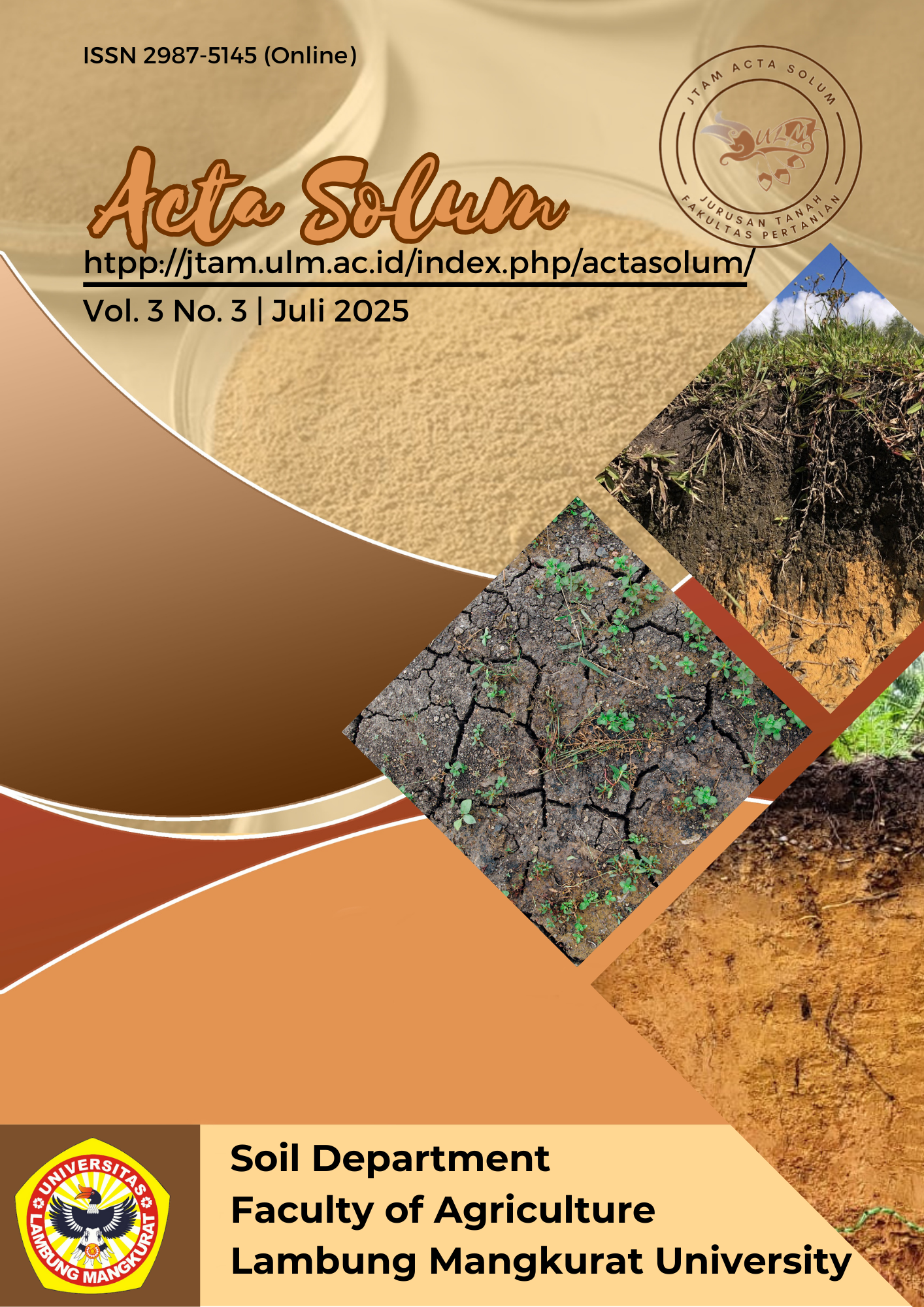
Soil contamination by heavy metals poses a significant threat to sustainable agriculture, especially in areas adjacent to industrial zones. This study demonstrates that while the initial application of the biosilica-humic acid (BSi-HA) soil amendment did not result in statistically significant changes in soil chemical properties within the first 7 days of incubation, prolonged incubation for 60 days revealed meaningful effects, particularly in reducing heavy metal availability in soil. Significant decreases in iron (Fe) and lead (Pb) concentrations were observed over time, with Fe reductions ranging from 45–67% and Pb reductions between 8–40%. These results are attributed to the synergistic effect of functional groups in BSi-HA—especially the carboxyl (–COOH) and hydroxyl (–OH) groups in humic acid—which exhibit high metal-binding affinity under acidic conditions (pH ~5). Although soil fertility parameters such as C-organic content and cation exchange capacity (CEC) showed a declining trend due to microbial activity during incubation, the ability of BSi-HA to immobilize heavy metals without exceeding safe thresholds highlights its potential as a sustainable soil amendment. Moreover, previous findings indicating reductions of up to 90% for Pb and 76% for Cd in plant tissues further support the efficacy of BSi-HA in mitigating heavy metal contamination in agricultural soils near industrial zones. Further long-term studies are recommended to evaluate BSi-HA's remediation capacity, persistence, and impact on crop yield and food safety. Combining biosilica and humic acid offers a promising, eco-friendly approach for managing heavy metal contamination in soils.
References
Adnan, M., Xiao, B., Xiao, P., Zhao, P., Li, R., Bibi, S. 2022. Research progress on heavy metals pollution in the soil of smelting sites in China. Toxics, 10(5), 1–30. https://doi.org/10.3390/toxics10050231
Bibi, M., Samiullah, F.B., Saba Afzal, S. 2023. Essential and non-essential heavy metals sources and impacts on human health and plants. Pure and Applied Biology (PAB) 12(2), 835-847. https://doi.org/10.1016/j.scitotenv.2023.163968
Boguta, P., D’Orazio, V., Senesi, N., Sokołowska, Z., Szewczuk-Karpisz, K. 2019. Insight into the interaction mechanism of iron ions with soil humic acids. The effect of the pH and chemical properties of humic acids. Journal of Environmental Management 245, 367–374. https://doi.org/10.1016/j.jenvman.2019.05.098
BPSI Tanah dan Pupuk. 2023. Analisis Kimia Tanah, Tanaman, Air, dan Pupuk. In Petunjuk Teknis Edisi. Retrieved from https://tanahpupuk.bsip.pertanian.go.id
Cai, Z., Ren, B., Xie, Q., Deng, X., Yin, W., Chen, L. 2024. Assessment of health risks posed by toxicological elements of the food chain in a typical high geologic background. Ecological Indicators 161, 111981. https://doi.org/10.1180/gbi.2024.4
Chakim, M.G., Mindari, W., Widjajani, B.W. 2022. The potential of organomineral amendments in increasing the adsorption of lead (Pb) and cadmium (Cd) in a sandy loam soil. Journal of Degraded and Mining Lands Management 9(4), 3753–3762. https://doi.org/10.15243/jdmlm.2022.094.3753
Chen, S., Ding, Y. 2023. Tackling heavy metal pollution: Evaluating governance models and frameworks. Sustainability 15(22), 1–12. https://doi.org/10.3390/su152215863
Dewi, W.S., Romadhon, M.R., Amalina, D.D., Aziz, A. 2022. Paddy soil quality assessment to sustaining food security. In IOP Conference Series: Earth and Environmental Science 1107(1), 012051. https://doi.org/10.1088/1755-1315/1107/1/012051
Dewi, W.S., Amalina, D.D., Romadhon, M.R. 2023. Microbial biofilm for soil health, plant growth, and productivity under multi stress. A review. IOP Conference Series: Earth and Environmental Science 1162(1), 012008. https://doi.org/10.1088/1755-1315/1162/1/012008
Fatima, N., Jamal, A., Huang, Z., Liaquat, R., Ahmad, B., Haider, R., Ali, M.I., Shoukat, T., ALOthman, Z.A., Ouladsmane, M., Ali, T., Ali, S., Akhtar, N., Sillanpää, M. 2021. Extraction and chemical characterization of humic acid from nitric acid treated lignite and bituminous coal samples. Sustainability 13(16), 8969. https://doi.org/10.3390/su13168969
Herawati, A., Mujiyo, M., Dewi, W.S., Syamsiyah, J., Romadhon, M.R. 2024. Improving microbial properties in Psamments with mycorrhizal fungi, amendments, and fertilizer. Eurasian Journal of Soil Science 13(1), 59-69. https://doi.org/10.18393/ejss.1396572
Hindarso, H., Epriliati, I., Hoerudin, D., Yuliani, S. 2021. Synthesis and characterization of biosilica from rice husks as a catalyst for the production of biodiesel. Fine Chemical Engineering 2(2), 41–46. https://doi.org/10.37256/fce.222021735
Khasanah, U., Mindari, W., Suryaminarsih, P. 2021. Kajian pencemaran logam berat pada lahan sawah di kawasan industri Kabupaten Sidoarjo. Jurnal Teknik Kimia 15(2), 73. https://doi.org/10.33005/jurnal_tekkim.v15i2.2545
Kong, B., Wu, Q., Li, Y., Zhu, T., Ming, Y., Li, C., Li, C., Wang, F., Jiao, S., Shi, L., Dong, Z. 2022. The application of humic acid urea improves nitrogen use efficiency and crop yield by reducing the nitrogen loss compared with urea. Agriculture 12(12), 1996. https://doi.org/10.3390/agriculture12121996
Lei, C., Yan, B., Chen, T., Xiao, X. 2018. Preparation and adsorption characteristics for heavy metals of active silicon adsorbent from leaching residue of lead-zinc tailings. Environ Sci Pollut Res. 25, 21233-21242. https://doi.org/10.1007/s11356-018-2194-9
Liang, G., Zhang, L. 2020. An improved process for the preparation of high-quality bio-silica microparticles from rice husk ash. Waste and Biomass Valorization 11(5), 2227–2233. https://doi.org/10.1007/s12649-018-0445-0
Mindari, W., Santoso, S.B., Rahayu, R.D. 2021. Effectiveness of ameliorant humic acid and silica based on availability of sandy soil nitrogen for rice. International Seminar of Research Month 2021, 430–434. https://doi.org/10.11594/nstp.2022.2467
Mindari, W., Sasongko, P.E., Aditya, H.F., Karam, D.S., Masri, I.N. 2023. Fertility index of industrial polluted land and plant response to heavy metal contamination. Malaysian Journal of Soil Science 27, 125–137. Retrieved from https://msss.com.my/mjss/Full%20Text/vol27/V27_10.pdf
Mindari, W., Sassongko, P.E., Syekhfani. 2022. Asam Humat Sebagai Amelioran dan Pupuk (3rd ed.). UPN “ Veteran” Jawa Timur, Surabaya. Retrieved from https://repository.upnjatim.ac.id/4125/1/Asam_humat_edisi%203.pdf
Mohammadi, A.A., Zarei, A., Esmaeilzadeh, M., Taghavi, M., Yousefi, M., Yousefi, Z., Sedighi, F., Javan, S. 2020. Assessment of heavy metal pollution and human health risks assessment in soils around an industrial zone in Neyshabur, Iran. Biological Trace Element Research 195(1), 343–352. https://doi.org/10.1007/s12011-019-01816-1
Muttaqien, K., Haji, A.T.S., Sulianto, A.A. 2020. Analisis kesesuaian lahan tanaman padi yang berkelanjutan di Kabupaten Indramayu. Jurnal Ilmiah Rekayasa Pertanian dan Biosistem 8(1), 48–57. https://doi.org/10.29303/jrpb.v8i1.168
Pachideh, G., Gholhaki, M., Rezaifar, O. 2021. Experimental study on engineering properties and microstructure of expansive soils treated by lime containing silica nanoparticles under various temperatures. Geotechnical and Geological Engineering 39(6), 4157–4168. https://doi.org/10.1007/s10706-021-01744-9
Sarlaki, E., Paghaleh, A.S., Kianmehr, M.H. 2020. Chemical , spectral and morphological characterization of humic acids extracted. Chemistry & Chemical Technology 14(3), 353–361. https://doi.org/10.23939/chcht14.03.353
Schaller, J., Frei, S., Rohn, L., Gilfedder, B.S. 2020. Amorphous silica controls water storage capacity and phosphorus mobility in soils. Frontiers in Environmental Science 8, 94. https://doi.org/10.3389/fenvs.2020.00094
Shammi, S.A., Salam, A., Khan, M.A.H. 2021. Assessment of heavy metal pollution in the agricultural soils, plants, and in the atmospheric particulate matter of a suburban industrial region in Dhaka, Bangladesh. Environmental Monitoring and Assessment 193, 141. https://doi.org/10.1007/s10661-021-08848-y
Siam, H.S., Abd El-Moez, M.R., Abou Zeid, S.T., Holah, S.S. 2019. Effect of silicon addition to different fertilizer on the yield, Cu and Zn content of rice plants (Oryza sativa L.). Plant Archives 19(2001), 2219–2225. Retrieved from https://www.semanticscholar.org/paper/EFFECT-OF-SILICON-ADDITION-TO-DIFFERENT-FERTILIZER-Siam-El-Moez/c9d8822a7ec047eebe3089e5ecbae4bccb035f51
Sukarman, N., Gani, R.A. 2020. Lahan bekas tambang timah di Pulau Bangka dan Belitung, Indonesia dan kesesuaiannya untuk komoditas pertanian. Jurnal Tanah d Iklim 41(2), 101-114. https://doi.org/10.21082/jti.v41n2.2017.101-114
Tiemann, T., Douxchamps, S. 2023. Opportunities and challenges for integrated smallholder farming systems to improve soil nutrient management in Southeast Asia. World Development Sustainability 3, 100080. https://doi.org/10.1016/j.wds.2023.100080
Yang, F., Antonietti, M. 2020. Artificial humic acids: Sustainable materials against climate change. Advanced Science 7(5), 1–7. https://doi.org/10.1002/advs.201902992
Wang, Z., Shen, T., Yang, Y., Gao, B., Wan, Y., Li, Y. C., Yao, Y., Liu, L., Tang, Y., Xie, J., Ding, F., Chen, J. 2020. Fulvic acid-like substance and its characteristics, an innovative waste recycling material from pulp black liquor. Journal of Cleaner Production 243(61), 118585. https://doi.org/10.1016/j.jclepro.2019.118585
Xu, S., Zhou, Z., Liu, K. 2020. Multi-evolutionary game research on heavy metal pollution control in soil: Based on a third-party perspective. Sustainability 12(13), 5306. https://doi.org/10.3390/su12135306
Downloads
Published
How to Cite
Issue
Section
License
Copyright (c) 2025 Muhammad Ghufron Chakim, Wanti Mindari, Purnomo Edi Sasongko

This work is licensed under a Creative Commons Attribution-ShareAlike 4.0 International License.