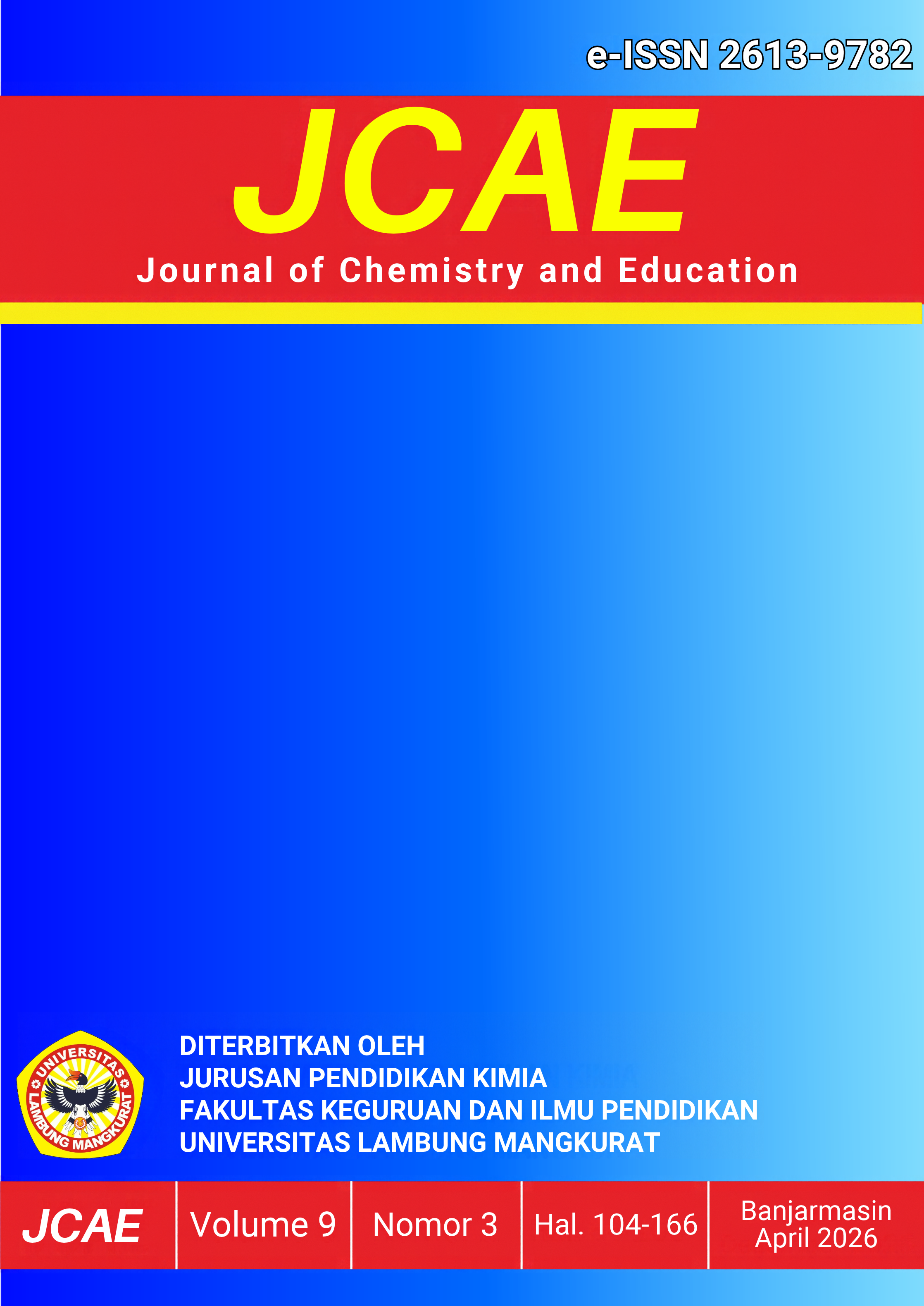
PERSEPSI SISWA TERHADAP LINGKUNGAN BELAJAR LABORATORIUM KIMIA DI TIGA SMA NEGERI BANJARMASIN: SURVEI DESKRIPTIF MENGGUNAKAN CHEMISTRY LABORATORY ENVIRONMENT INVENTORY (CLEI)
DOI:
https://doi.org/10.20527/jcae.v9i3.3883Keywords:
Chemistry Laboratory Environment Inventory, Laboratorium Kimia, lingkungan belajar, persepsi siswa, survei deskriptifAbstract
Lingkungan belajar laboratorium kimia merupakan konstruksi multidimensional yang mencakup aspek sosial, pedagogis, prosedural, dan material, Penelitian ini bertujuan untuk mendeskripsikan persepsi siswa terhadap lingkungan belajar laboratorium kimia di tiga SMA Negeri di Banjarmasin menggunakan Chemistry Laboratory Environment Inventory (CLEI). Penelitian ini menggunakan pendekatan kuantitatif dengan metode survei deskriptif. Responden penelitian berjumlah 248 siswa kelas X dan XI yang telah mengikuti kegiatan praktikum kimia. Data dikumpulkan menggunakan angket CLEI yang terdiri atas 35 butir dalam lima dimensi, yaitu student cohesiveness, open-endedness, integration, rule clarity, dan material environment. Data dianalisis menggunakan skor rata-rata dan persentase capaian. Hasil penelitian menunjukkan bahwa rule clarity memperoleh persentase tertinggi sebesar 84,99%, diikuti oleh integration sebesar 82,24% dan material environment sebesar 81,08%, yang termasuk kategori sangat baik, student cohesiveness memperoleh 74,22% dan termasuk kategori baik, sedangkan open-endedness memperoleh persentase terendah sebesar 52,13% dan termasuk kategori cukup. Temuan menunjukkan bahwa siswa memersepsikan lingkungan laboratorium secara positif, terutama pada aspek kejelasan aturan, keterkaitan praktikum dengan pembelajaran di kelas, serta kondisi material. Sebaliknya, kesempatan untuk melakukan eksplorasi dan penyelidikan yang lebih terbuka masih dipersepsikan sebagai relatif terbatas, Rendahnya capaian open-endedness menjadi dasar untuk mempertimbangkan pengembangan kegiatan praktikum yang memberi ruang lebih besar bagi inisiatif dan pengambilan keputusan siswa secara bertahap tanpa mengurangi aspek keselamatan dan struktur laboratorium.
Abstract. The chemistry laboratory learning environment is a multidimensional construct encompassing social, pedagogical, procedural, and material aspects. This study aimed to describe students' perceptions of the chemistry laboratory learning environment in three public high schools in Banjarmasin using the Chemistry Laboratory Environment Inventory (CLEI). A quantitative descriptive survey was employed, The respondents were 248 students in Grades X and XI who had participated in chemistry laboratory activities. Data were collected using a 35-item CLEI questionnaire covering five dimensions: student cohesiveness, open-endedness, integration, rule clarity, and material environment. The data were analyzed using mean scores and percentage achievement, Rule clarity obtained the highest percentage (84,99%), followed by integration (82,24%) and material environment (81,08%), all categorized as very good, Student cohesiveness reached 74,22% and was categorized as good, whereas open-endedness obtained the lowest percentage (52,13%) and was categorized as sufficient. The findings indicate that students perceived the laboratory environment positively, particularly in terms of rule clarity, the connection between laboratory activities and classroom learning, and material conditions. In contrast, opportunities for more open exploration and investigation were perceived as relatively limited. The lower open-endedness score suggests a need to gradually expand opportunities for student initiative and decision-making while maintaining laboratory safety and structure.
References
Agunbiade, O. D., & Odeleye, O. O. (2026). An Exploration of Students’ Perceptions of Organic and General Chemistry Laboratories: A Pilot Study. Journal of Chemical Education, 103(6), 2854–2862. https://doi.org/10.1021/acs.jchemed.5c01528.s004
Ahdila, A. I., Masykuri, M., & Hastuti, B. (2022). Efektivitas pemanfaatan laboratorium dalam pembelajaran kimia di SMA Negeri 2 Boyolali. Jurnal Pendidikan Kimia, 11(2), 205–2010. https://doi.org/10.20961/jpkim.v11i2.63552
Baars, S., Schellings, G. L. M., Krishnamurthy, S., Joore, J. P., den Brok, P. J., & van Wesemael, P. J. V. (2021). A framework for exploration of relationship between the psychosocial and physical learning environment. Learning Environments Research, 24(1), 43–69. https://doi.org/10.1007/s10984-020-09317-y
Cresswell, J. W., & Creswel, J. D. (2023). Research Design (6 th ed). SAGE Publications Sage CA: Los Angeles, CA.
Cruchinho, P., López-Franco, M. D., Capelas, M. L., Almeida, S., Bennett, P. M., da Silva, M. M., Teixeira, G., Nunes, E., Lucas, P., & Gaspar, F. (2024). Translation, Cross-Cultural Adaptation, and Validation of Measurement Instruments: A Practical Guideline for Novice Researchers. Journal of Multidisciplinary Healthcare, 17, 2701–2728. https://doi.org/10.2147/JMDH.S419714
Fraser, B. J., Giddings, G. J., & McRobbie, C. J. (1992). Assessment of the psychosocial environment of university science laboratory classrooms: A cross-national study. Higher Education, 24(4), 431–451. https://doi.org/10.1007/BF00137241
Fraser, B. J., McRobbie, C. J., & Giddings, G. J. (1993). Development and cross-national validation of a laboratory classroom environment instrument for senior high school science. Science Education, 77(1), 1–24. https://doi.org/10.1002/sce.3730770102
Hensley, M, S., B., N, L., Galerneau, A, J., Bekkala, A. P., & Hungwe, K. N. (2024). Beyond intentions: Understanding the gap between safety education and student behaviors. Journal of Chemical Education, 101(3), 798–806. https://doi.org/10.1021/acs.jchemed.3c00620
Hidayah, F. F., Imaduddin, M., Yuliyanto, E., Tantayanon, S., & Djunaidi, M. C. (2021). Depicting Chemistry Teachers’ Perception of Laboratory Environment and Teaching Satisfaction. İlköğretim Online, 20(1), 1340–1350. https://doi.org/10.17051/ILKONLINE.2021.01.129
Hughes, B. S., Corrigan, M. W., Grove, D., Andersen, S. B., & Wong, J. T. (2022). Integrating arts with STEM and leading with STEAM to increase science learning with equity for emerging bilingual learners in the United States. International Journal of STEM Education, 9(1), 58. https://doi.org/10.1186/s40594-022-00375-7
Jegstad, K. M. (2024). Inquiry-based chemistry education: a systematic review. Studies in Science Education, 60(2), 251–313. https://doi.org/10.1080/03057267.2023.2248436
Lathifah, A. I., Dwi M, H., Siti Fauziah, E., Suryani, E., & Lisdiana, H. (2023). Analisis persepsi mahasiswa pendidikan kimia terhadap kualitas laboratorium kimia kampus. Jurnal Riset Pendidikan Kimia (JRPK), 13(2), 85–94. https://doi.org/10.21009/JRPK.132.01
Memmen, J,, & Markic, S. (2025). Codesigning learning for the future: Participatory development of a student laboratory to promote transversal skills Codesigning learning for the future: Participatory development of a student laboratory to promote transversal skills. Journal of Chemical Education, 102(10), 4278–4288. https://doi.org/10.1021/acs.jchemed.5c00748
Mundy, C. E., Potgieter, M., & Seery, M. K. (2023). A design-based research approach to improving pedagogy in the teaching laboratory. Chemistry Education Research and Practice, 25(1), 266–275.
Polk, M. E., & Santos, D. L. (2025). Science Practices in Action: Group Engagement with Different Degrees of Inquiry in General Chemistry Laboratory [Research-article]. Journal of Chemical Education, 102(4), 1380–1388. https://doi.org/10.1021/acs.jchemed.4c01314
Sokic-Lazic, D,, Throgmorton, J, C., & Snoderly-Foster, L, J. (2025). Targeted chemistry laboratory curriculum enhancements: Transforming student perceptions by integrating real-world contexts in large-scale laboratories. Journal of Chemical Education, 102(8), 3425–3435. https://doi.org/https://doi.org/10.1021/acs.jchemed.5c00286
Suryani, E,, Hayatunnisa, Lisdiana, H,, & Sriyuliani, R. (2024). Analisis persepsi mahasiswa terhadap lingkungan pembelajaran di laboratorium kimia pada mata kuliah Praktikum Kimia Organik. Jurnal Riset Pendidikan Kimia (JRPK), 14(2), 150–156. https://doi.org/https://doi.org/10.21009/JRPK.142.10
Varadarajan, S,, & Ladage, S. (2022). Introducing incremental levels of inquiry in an undergraduate chemistry laboratory: A case study on a short lab course. Journal of Chemical Education, 99(12), 3822–3832. https://doi.org/https://doi.org/10.1021/acs.jchemed.2c00297
Wong, A. F, L., & Fraser, B. J. (1997). Assessment of chemistry laboratory classroom environments. Asia Pacific Journal of Education, 17(2), 41–58. https://doi.org/https://doi.org/10.1080/02188799708547761
Downloads
Published
How to Cite
Issue
Section
License
Copyright (c) 2026 JCAE (Journal of Chemistry And Education)

This work is licensed under a Creative Commons Attribution-NonCommercial-NoDerivatives 4.0 International License.